Africa / English
 Europe / English
 France
 APAC / English
 India / English
 Latin America / Español
 US / English
Whether you are an expert car-maintenance DIYer, or you are just starting out, you need to know some basic information about your engine, and AMSOIL is here to help. When estimating how much oil your car needs…
You can estimate how much oil your car needs by counting its cylinders.
- A four-cylinder engine takes about 3.5 -4.5 liters of oil
- A six-cylinder engine needs about 4.5 – 5.5 liters of oil
- An eight-cylinder engine takes about 5.5 – 7.5 liters of oil
This is only an approximation, however.
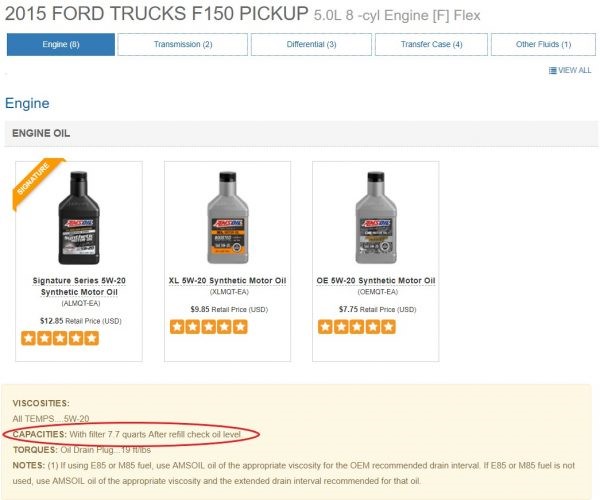
To find out precisely how much motor oil your car needs, check the AMSOIL Product Guide: You can skip hassle and use our Product Guide to find out how much oil your car needs. Just input your vehicle information and, below the motor oil recommendations, you’ll find motor oil capacity (circled below in red).
What If the Oil Level Is Too Low?
It could be due to a couple issues, including insufficient oil added during the last oil change or oil consumption. There are several reasons for oil consumption. But here are a couple of the more common.
Leaking seals or gaskets – your engine uses seals in various places to ensure oil stays inside the engine while contaminants stay out. A prime example is around the crankshaft where it protrudes from the engine and connects to the transmission. Gaskets seal the uneven metal surfaces between parts to ensure, in part, that oil stays inside the engine. The cylinder head gasket is a notable example.
If the seals and gaskets become worn, brittle or deformed over time, they can result in oil leaks. The engine oil level will drop, depending on the severity of the leak.
If Your Engine Leaks Oil, Visit A Mechanic and Have It Fixed!
Volatility – engine oil can evaporate when exposed to heat. The less stable the oil, the more readily it evaporates. As the engine is running, a thin film of oil coats the cylinder wall and piston skirt. Given its proximity to the fiery cauldron inside the combustion chamber, the oil in this area of the engine can easily volatilize or evaporate. The by-products can exit the tailpipe as emissions. But they can also form harmful carbon deposits inside the engine that reduce efficiency and eventually lead to engine failure.
Synthetic motor oil is more resistant to volatility than conventional oil, so use a good synthetic to reduce oil consumption due to volatility and help keep your engine clean.
What If the Oil Level Is Too High?
It’s likely due to operator error; someone simply added too much last time the oil was changed or topped-off.
Too much oil is a bad thing. The spinning crankshaft and churning engine parts whip air into the oil, which can cause foam. The tiny bubbles travel between moving parts, where they rupture. When they do, nothing is left to protect metal surfaces from wear. Foam also increases heat, which causes the oil to chemically breakdown sooner.
If the crankcase is overfull, drain the excess oil until reaching the correct level.
Increased oil levels can also be due to fuel dilution. This is when fuel enters the crankcase and contaminates the oil. In severe cases, enough fuel can enter the crankcase to noticeably increase the oil level. This is bad. Very bad. Fuel dilution leads to sludge, varnish and engine wear.
The presence of coolant in the oil can also increase oil level. Again, this is bad. Anytime something that shouldn’t be in your motor oil is present, wear protection suffers. Coolant in the oil is likely due to a bad head gasket, which is a costly repair.
One last word of advice: check your oil at least monthly to ensure the proper level. Make sure the vehicle is parked on a level surface to get an accurate reading. Finding out the oil is too low or too high before something goes wrong can save you a ton of grief in the long run.